External Data
Enhance models in Alviss AI with built-in external data for weather and macroeconomic indicators.
Overview
To simplify data integration for our users, Alviss AI provides built-in external data sources for weather and macroeconomic factors. These can be automatically added during Dataset creation or extension, enriching your models with contextual variables without manual uploads. This feature supports more accurate attributions, simulations, predictions, and optimizations by accounting for environmental and economic influences on your KPIs.
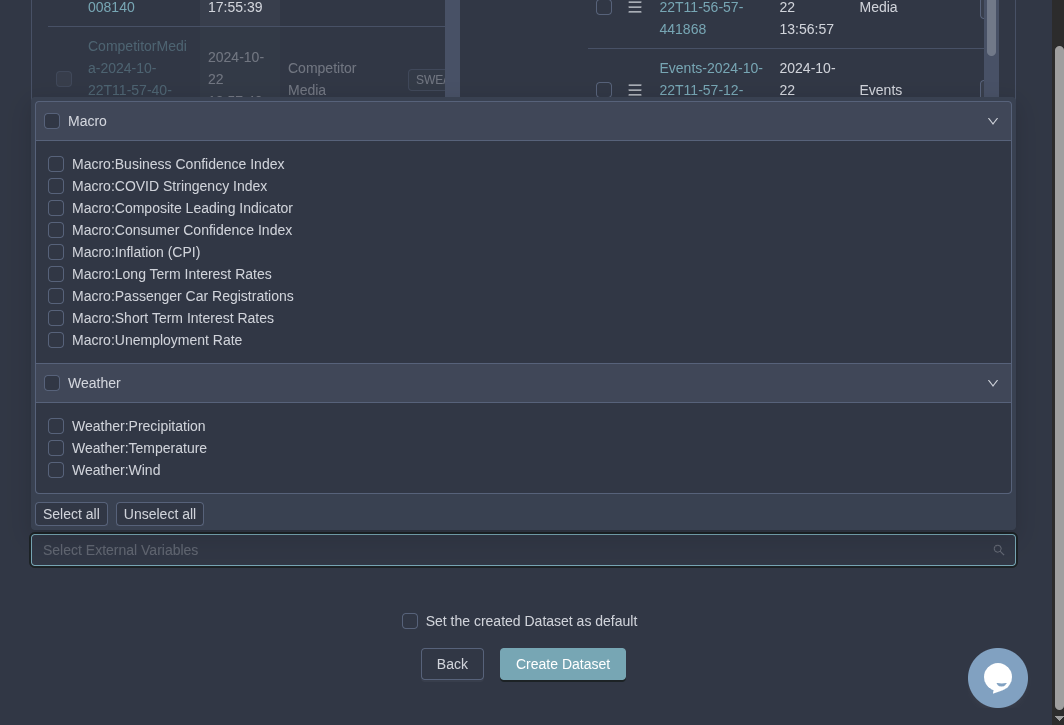
External data is sourced from reliable providers and tailored to your project's Country and Region. For multi-country Datasets, indicators are added where available; unavailable countries are skipped without error.
External data respects your project's Periodicity, aggregating values (e.g., averages or sums) to match intervals like weekly or monthly.
Weather
Weather data helps model impacts from environmental conditions, such as how precipitation affects foot traffic or temperature influences demand for seasonal products. Sourced from Meteostat, we sample from weather stations near the country's capital by default. If a valid ISO 3166-2 code is provided in the Region field, sampling shifts to the largest city in that region (based on population) for more localized accuracy.
Supported indicators:
- Temperature: The average air temperature in °C.
- Precipitation: The daily precipitation total in mm.
- Wind: The average wind speed in km/h.
To include weather:
- During Dataset creation, select "Add External Variables" and choose Weather indicators.
- Data is auto-fetched and appended based on your Dataset's geographic scope.
For best results, use ISO-standard Region codes to enable precise, city-level sampling over capital defaults.
Macro
Macroeconomic data captures broader market trends, such as how unemployment affects consumer spending or inflation influences pricing strategies. Sourced from the OECD, availability varies by country—not all indicators are supported everywhere. For Datasets with multiple countries, we add indicators where possible and skip unavailable ones.
Supported indicators:
- Unemployment Rate: Percentage of the labor force without work but available and seeking employment (% of labour force).
- Inflation (CPI): Change in consumer prices for a basket of goods and services (Annual Growth Rate %).
- Long-term Interest Rates: Rates on government bonds maturing in ten years (% per annum).
- Short-term Interest Rates: Rates on three-month money market or government paper (% per annum).
- Passenger Car Registrations: Number of new passenger vehicle registrations (Baseline 2015).
- Business Confidence Index: Composite indicator of business sentiment (Baseline of 100).
- Consumer Confidence Index: Composite indicator of consumer sentiment (Baseline of 100).
- Composite Leading Indicator: Aggregated indicators predicting economic cycles (Baseline of 100).
- COVID Stringency Index: Measure of government response restrictions, scaled from 0 to 100 (100 = strictest).
To include macro data:
- During Dataset creation or extension, select "Add External Variables" and choose desired indicators.
- Data is fetched and integrated based on your Dataset's countries and time periods.
If an indicator is unavailable for a country in your Dataset, that country will be skipped for that variable—no data gaps are introduced.
For more on incorporating external data into workflows, see Datasets or Models. If you need custom external sources, explore the API for integration.
Updating Variables
When extending an existing Dataset with new uploads that include additional dates (beyond those in the original Dataset), Alviss AI automatically fetches and appends updated data for any external variables already included. This ensures your Dataset remains comprehensive and up-to-date without manual intervention.
For example:
- If your Dataset includes weather indicators like Temperature or Precipitation, new data points will be retrieved from Meteostat to cover the extended time period.
- Similarly, for macroeconomic factors like Unemployment Rate or Inflation (CPI), fresh data from the OECD will be added where available.
This seamless update maintains data consistency and supports accurate modeling, simulations, and insights over expanded timelines.
:::note Extensions create a new immutable Dataset version, preserving traceability. See Datasets for details on the extension process. :::